
December 14, 2025
India Dominates South Africa in Dharamshala to Move Ahead 2–1 in T20I Series
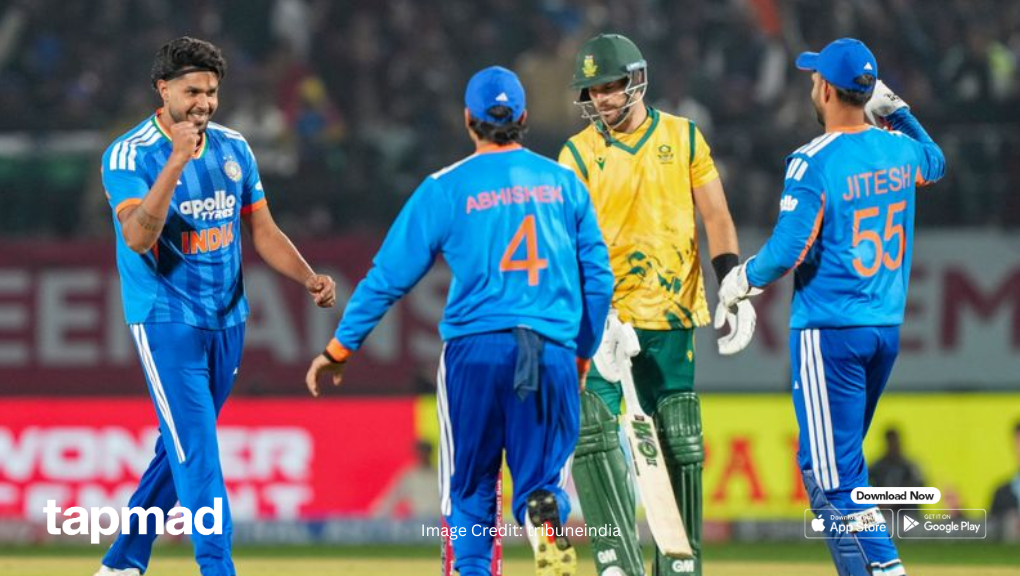

India delivered a complete performance under lights at the HPCA Stadium, overpowering South Africa by 7 wickets in the 3rd T20I to take a 2–1 lead in the five-match series. The result reflected India’s control across both innings, shaped by incisive bowling and a fearless opening stand that removed any doubt early in the chase.
Seam, Swing, and South Africa’s Early Trouble
India’s decision to bowl first proved decisive on a pitch that offered movement and carry from the opening over. Arshdeep Singh struck with discipline and intent, drawing false shots with late swing and tight lines. Harshit Rana complemented him by hitting the deck hard and forcing batters into rushed decisions.
South Africa never found stability during the powerplay. Early wickets pushed them into recovery mode before the innings had settled. Varun Chakravarthy and Kuldeep Yadav tightened the screws through the middle overs, cutting off scoring options and forcing South Africa into low-percentage shots.
Markram Fights Alone as Collapse Deepens
Aiden Markram showed composure and clarity while wickets fell relentlessly around him. He paced his innings with intelligence, rotated strike when boundaries dried up, and punished errors with authority. His 61 from 46 balls carried South Africa through moments that otherwise threatened complete collapse.
Donovan Ferreira provided some resistance, yet partnerships never developed long enough to shift momentum. India’s bowlers attacked relentlessly, refusing to release pressure at any stage. The final phase proved decisive as South Africa lost their last six wickets for minimal returns, folding for 117 exactly at the end of their twentieth over.
India’s Bowling Unit Delivers Collective Impact
India’s bowling success rested on balance rather than brilliance from any single individual. Arshdeep Singh finished with 2 for 13, setting the tone early and closing overs cleanly. Harshit Rana claimed two crucial wickets despite conceding runs during aggressive spells.
Varun Chakravarthy and Kuldeep Yadav operated with control and variation, each picking up two wickets while conceding very little. Hardik Pandya and Shivam Dube chipped in effectively, maintaining pressure through disciplined lengths rather than raw pace.
Pandya reached a landmark moment during the innings, becoming the first fast-bowling all-rounder in men’s T20I history to complete 1,000 runs and 100 wickets. The achievement came quietly, fitting a performance built on collective execution rather than individual spotlight.
Explosive Opening Stand Ends the Contest Early
India’s chase began with intent and clarity. Abhishek Sharma attacked from the outset, trusting his instincts and exploiting the field restrictions. His 35 from 18 balls set the tempo and forced South Africa into defensive placements far earlier than planned.
Shubman Gill played the perfect counterbalance, anchoring the innings with patience and clean timing. The pair added 60 runs at speed, draining belief from the South African camp before the halfway mark of the chase.
By the time Abhishek departed, the equation no longer offered South Africa a realistic hope. Gill continued calmly until his dismissal, ensuring the required rate never climbed into dangerous territory.
Tilak and Dube Finish Without Drama
Tilak Varma and Shivam Dube handled the closing stages with assurance and composure. Tilak’s unbeaten 26 reflected maturity beyond his years, built on clean placement rather than force. Dube supported him comfortably, rotating strike and punishing loose deliveries when offered.
India crossed the line in the 16th over, finishing at 120 for three with 25 balls remaining. The ease of the chase highlighted the gap between the sides on the night.
A Statement Win Before the Series Climax
The victory carried significance beyond the margin. India adapted better to conditions, read the surface accurately, and executed plans with clarity. South Africa struggled to respond once early pressure exposed their fragile middle order.
With the series now tilted in India’s favor, attention shifts to Lucknow, where the 4th T20I will test South Africa’s ability to rebound quickly. India, meanwhile, carries momentum, balance, and confidence into the remaining fixtures.
Dharamshala witnessed a performance shaped by discipline, intent, and control. India did not chase the spectacular. They simply played smarter cricket, and the scoreboard told the story clearly.